


AI business model is at the core of any successful AI venture, The AI industry is rapidly growing, and entrepreneurs are increasingly asking how to structure their businesses effectively. Artificial Intelligence is no longer just a futuristic concept—it’s transforming industries from healthcare, finance, and logistics to marketing, education, and retail, Understanding the right approach is essential for generating revenue and scaling successfully.
Whether you’re creating a new AI startup or integrating AI into an existing business, a clear ai business plan will help define your strategy, revenue streams, and growth path, Aligning technology, data, and market demand ensures maximum profitability.
What Is an AI Business Model?
An AI business model defines how your AI product or service creates value and generates revenue, Unlike traditional businesses, AI ventures often rely on unique components such as data monetization, subscription-based services, or AI-powered platforms.
Key aspects include
- Data Strategy: How you will collect, process, and leverage data for your AI solution.
- Technology Stack: Which algorithms, machine learning frameworks, and cloud infrastructure will support your product.
- Customer Segmentation: Who will use and pay for your AI service.
- Revenue Streams: How the AI will generate recurring or one-time income.
Clearly defining these elements is essential in your ai business plan, which serves as a roadmap for investors, developers, and your internal team.
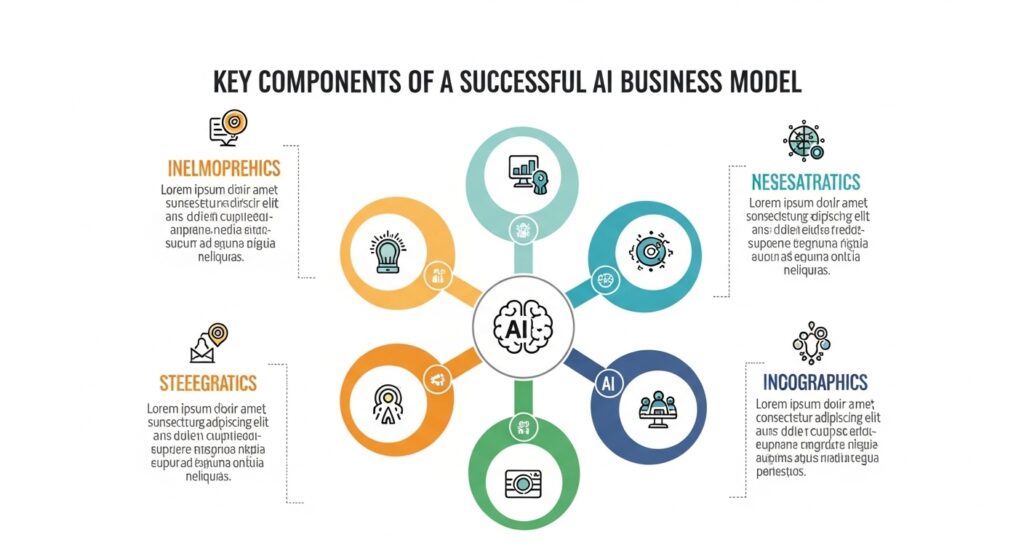
Key Components of a Successful AI Business Model
A successful AI venture relies on several essential components:
- Value Proposition: Clearly define the problem your AI solves and why customers should choose your solution.
- Revenue Streams: Determine whether your AI generates income through subscriptions, licensing, or service contracts.
- Market Fit: Validate demand for your AI solution before developing the product.
- Data Management: Ensure high-quality data collection, storage, and processing to power your AI effectively.
- Scalability: Design the solution so it can expand to new markets, datasets, or product features.
Focusing on these pillars ensures that your AI business model remains profitable and sustainable while meeting market needs.
Don’t Risk Your AI Idea Without a Clear Plan
Get expert guidance to structure your AI business model, forecast costs, and maximize profitability.
Book Your Free Consultation Now
How AI Business Models Generate Revenue
Understanding how an AI business model makes money is critical. Common monetization strategies include:
- SaaS (Software as a Service): AI tools offered on a subscription basis.
- Licensing AI Technology: Selling AI models, APIs, or algorithms to other businesses.
- Data Analytics Services: Offering insights from AI-powered analysis to organizations.
- AI-Powered Platforms or Marketplaces: Connecting users with AI solutions while taking a commission.
Your ai business plan should clearly define which of these approaches best suits your product and target audience.
Popular AI Business Models Examples
Entrepreneurs can adopt several proven AI business models
- Product-Based AI: Selling AI-powered tools or devices directly to consumers or businesses, Example: AI-driven automation software for enterprises.
- Service-Based AI: Providing AI consulting or custom AI solutions for clients. Example: AI recommendation engines for e-commerce platforms.
- Platform AI: Developing AI marketplaces or ecosystems that connect developers with users. Example: AI API platforms like OpenAI’s API.
- Data Monetization AI: Aggregating and analyzing data to sell insights or predictive models. Example: AI analytics for retail trends.
These models can be further detailed in your ai business plan to clarify operations, revenue, and growth potential.

Common Mistakes in AI Business Models
Many startups fail to optimize their AI business model due to:
- Neglecting the importance of data quality and volume.
- Focusing solely on AI technology rather than market needs.
- Underestimating development costs and infrastructure requirements.
- Skipping the creation of a detailed ai business plan.
Avoiding these mistakes increases the likelihood of building a sustainable AI business that attracts investors and customers
Launch Your AI Venture Faster With Launchly
If you want to streamline your AI startup planning, Launchly helps entrepreneurs validate ideas, design AI business models, and create actionable ai business plans quickly.
Instead of spending months figuring out revenue streams, data strategies, or scalability, Launchly provides step-by-step guidance, templates, and frameworks to take your project from concept → planning → execution, With Launchly, you can confidently launch AI solutions that are profitable and scalable.
Get Started with Launchly Today and Build Your AI Business Model with Confidence!
Frequently Asked Questions
How to start business in AI?
Begin by identifying a real problem that AI can address, Conduct market research to validate demand, outline your strategy, and create a detailed plan before building the technology.
How does an AI model make money?
AI models generate revenue through SaaS subscriptions, licensing, data analytics, or AI-powered platforms connecting users with solutions.